
Here in the season of Advent, I want to look a little more closely at the familiar stories of Jesus’ birth in the gospel of Matthew to help us see some of the things we may otherwise miss in this story that are so familiar to us.
Now the birth of Jesus the Messiah took place in this way. When his mother Mary had been engaged to Joseph, but before they lived together, she was found to be pregnant from the Holy Spirit. (Matthew 1:18)
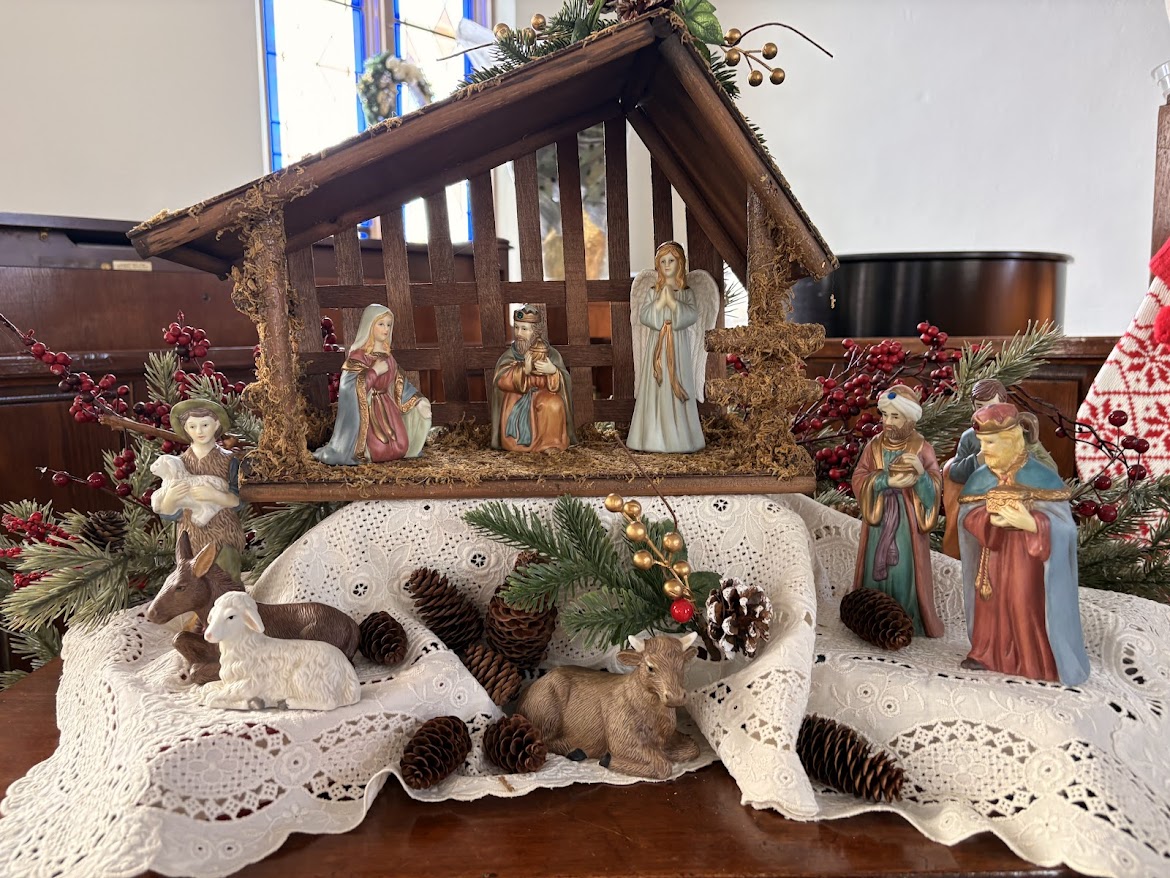
As I write this morning from my living room, in front of me is a traditional creche, or manger scene. In the center is the angel standing with Mary and Joseph along with the manger. To the right I see three magi with their gifts of frankincense, gold, and myrrh, plus a lone camel. I guess they all rode on one camel! And to the left are two shepherds, a couple of sheep, a cow and a donkey. What’s wrong with this scene?
In a way nothing is wrong, other than the fact that these characters are never in one place all together in the gospels. Go ahead and read Matthew 1 & 2 and tell me where are the shepherds. Or Luke 1 & 2 and point out the Wise Men.
In our minds, we have taken the stories of Jesus’ birth and mashed them into one story, and that’s okay. But it costs us understanding each writer’s intent. They told different stories because they had different purposes.
Matthew is writing to a more traditional, Jewish audience. You will notice Joseph takes center stage, not Mary. Mary is the central character in Luke’s gospel where the emphasis is on the powerless and outcasts.
Matthew emphasizes Joseph’s connection to King David, placing Jesus in a royal line. Who else would welcome a prince but exotic visitors from the east bearing expensive gifts? In Luke, that royal lineage is connected through Bethlehem, that diminutive, “little town of” David’s line.
Finally, Matthew wants his audience to know that Jesus is the fulfillment of Israel’s hopes, the long-awaited Messiah. See, just like Isaiah prophesied long ago, “a virgin shall become pregnant and give birth to a son.” [Not to go too deep in the weeds, but that’s not really what it says in Hebrew, but it worked for Matthew.]
I still enjoy my manger scene with its whole cast of characters. When my girls were younger, sometimes Rudolph and Yukon Cornelius would find their way into the scene, too. But I also appreciate Matthew’s story which tells me Joseph named the child Jesus, which means “deliverer,” “for he will save his people from their sins.” And the child is “Emmanuel, which means God is with us.”
In this season of Advent, Matthew calls us to reflect on what exactly are the “sins” from which we need saved, and what it means that God is with us as we are delivered? And looking ahead, we may start to wonder why Herod was so worried about what those Wise Men might find?
Until next week, Advent blessings!